Mastering the Three Pillars of Circular Arc Gear Manufacturing
author: Cash
2026-06-23
Precision in Every Arc: Mastering the Three Pillars of Circular Arc Gear Manufacturing | Gearseiko
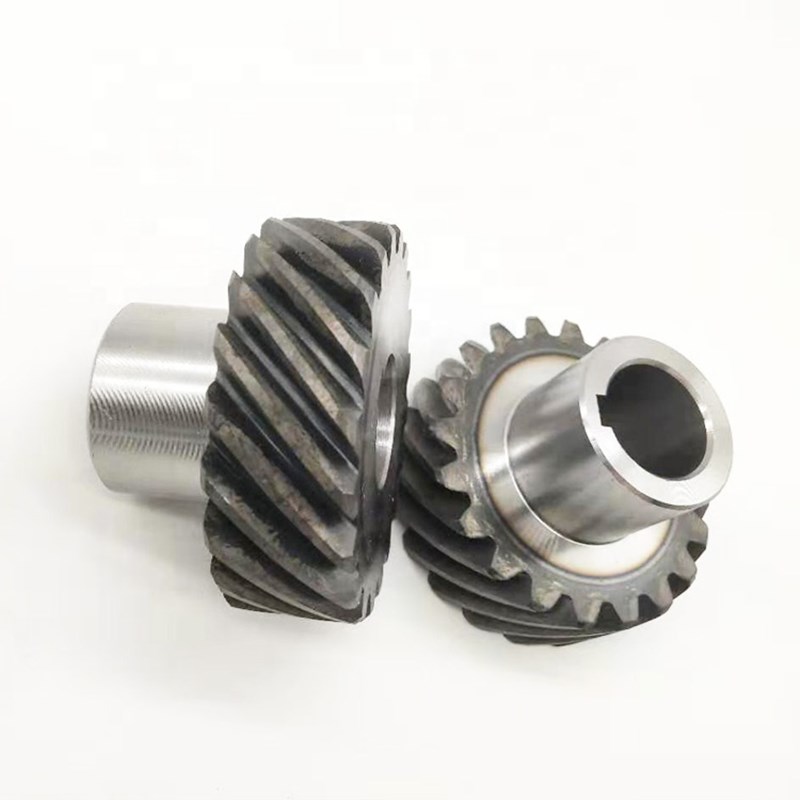
In high-performance power transmission fields, circular arc gears boast unique structural advantages compared with traditional involute gears. Different from involute gears adopting transverse contact ratio for power transmission, circular arc gears rely on longitudinal contact ratio, with contact points moving axially along the helical path during meshing. This unique meshing principle puts forward extremely strict requirements on manufacturing precision. Gearseiko clarifies that the overall transmission performance, load capacity and service life of circular arc gears are dominated by three core precision indicators: axial pitch accuracy, helix lead precision and tooth profile geometry control. This article elaborates our mature manufacturing technology covering these three core pillars.
1. Axial Pitch Accuracy: Core Foundation for Stable Continuous Meshing
Supported purely by longitudinal contact ratio, circular arc gears have contact points moving stably along helical lines during operation. Any tiny axial pitch error will break continuous meshing motion, triggering abnormal vibration, running noise and accelerated tooth surface wear, which is the primary failure cause of arc gear transmission systems.
Gearseiko adopts multi-dimensional closed-loop control to guarantee ultra-high axial pitch precision: During CNC gear hobbing, we minimize the parallelism error between hob guide rail and workpiece spindle axis close to zero; technicians double-check workpiece clamping alignment before processing; differential change gear parameters are calculated and verified twice manually and digitally to eliminate cumulative meshing errors. Besides, all CNC hobbing and grinding machines accept regular professional calibration. Our finished circular arc gears stably comply with GB/T 15753-1995 Class 4 high-precision standards in terms of axial pitch tolerance.
2. Helix Lead Precision: Avoiding Partial Load Concentration
Helix angle deviation is a hidden failure factor severely damaging arc gear performance. Once the actual helix angle fails to match design parameters, inconsistent axial pitches will appear along the full tooth width, shortening effective meshing contact length. Consequently, gears suffer from unstable meshing state, uneven load distribution and local stress concentration, greatly shortening the fatigue service life of heavy-duty arc gears.
To solve this problem, Gearseiko equips all core processing equipment with high-rigidity machine tool structures and real-time online monitoring modules. Built-in thermal error compensation system offsets spindle thermal elongation caused by long-time continuous machining, avoiding helix lead drift induced by temperature rise. Every finished gear will undergo full-stroke helix lead detection via professional gear measuring instruments, ensuring consistent and qualified helical tooth trajectory for all teeth.
3. Tooth Profile Geometry Control: Decisive Factor for Meshing Contact Pattern
Tooth profile errors of circular arc gears fall into two major categories: intrinsic tooth profile geometric error, and radial profile offset relative to reference pitch circle. Both errors will directly change the contact point position along tooth height, and further affect gear load capacity and running-in performance.
3.1 Strict Full-Lifecycle Tool Management
Tooth profile accuracy is fundamentally determined by cutting tool precision. Gearseiko implements strict cutter inspection mechanism: any hobs and forming cutters with tiny profile wear or deformation will be scrapped immediately and prohibited from production. All finish machining tools must be reground and calibrated with master standard gauges before use to restore standard arc tooth profile, ensuring 1:1 replication of design tooth profile on workpieces.
3.2 Micron-Level Cutting Depth Closed-Loop Control
Cutting depth directly matches gear center distance, which greatly affects meshing contact points:
- Excessive cutting depth (equivalent to increased center distance): Convex tooth contact points shift toward tooth root, while concave tooth contact points shift toward tooth tip;
- Insufficient cutting depth (equivalent to reduced center distance): Convex tooth contact points shift toward tooth tip, while concave tooth contact points shift toward tooth root.
Both deviation conditions will destroy optimal meshing contact pattern, worsen running-in effect and reduce overall transmission efficiency and bearing capacity. Gearseiko’s high-precision CNC machining system locks cutting depth within micron tolerance range, realizing optimal contact pattern for arc gears during initial meshing.
4. Dual Manufacturing Processes: Forming Method & Generating Method
Gearseiko supports two mainstream manufacturing processes for circular arc gears to match different production batches and precision demands:
- Forming Method: Tooth profile is completely copied from cutter contour, so tool profile precision is the core guarantee of finished gear quality. Strict indexing accuracy and helix lead precision are required throughout processing.
- Generating Method: Standard tooth profile is formed via relative enveloping motion between cutter and workpiece. Although relying on linkage motion, high-precision hob profile still serves as an indispensable precondition for qualified products.
We configure independent production workshops for two processes respectively, realizing flexible switching according to customer batch size, precision grade and cost budget, providing targeted processing solutions.

5. Gearseiko Full-Process Precision Inspection Advantage
Circular arc gears are extremely sensitive to center distance fluctuation and cutting depth deviation, requiring full-process strict inspection rather than only finished product sampling. Gearseiko adopts high-precision coordinate measuring machines and professional comprehensive gear detectors to conduct full-item detection on axial pitch, helix lead, tooth profile error and meshing contact pattern. All detection data are archived completely, realizing traceable full production quality.
Our high-precision circular arc gears are widely applied in high-speed turbomachinery, heavy-duty industrial reducers and precision robotic transmission systems. Adhering to consistent precision manufacturing philosophy, Gearseiko provides reliable high-performance arc gear components for global transmission equipment manufacturers.
Three core precision controls: axial pitch, helix lead and tooth profile geometry, empowering stable and long-lasting service of high-performance circular arc gears.
FAQ | Circular Arc Gear Precision Manufacturing Technology
Q1: What is the core difference between circular arc gears and involute gears?
A1: Involute gears adopt transverse contact ratio for transmission, while circular arc gears rely on longitudinal contact ratio, with axial moving contact points, putting higher requirements on axial pitch and helix precision.
Q2: Why is axial pitch accuracy the top priority for arc gear production?
A2: Arc gears rely entirely on longitudinal meshing; tiny axial pitch errors will break continuous meshing, causing vibration, noise and rapid tooth surface wear.
Q3: How does cutting depth affect arc gear meshing performance?
A3: Cutting depth corresponds to gear center distance. Deviated cutting depth will shift meshing contact points, damage optimal contact pattern, and reduce load capacity and running-in performance.
Q4: What is the difference between forming method and generating method for arc gears?
A4: The forming method copies cutter tooth profile directly with high requirements on tool precision; the generating method forms tooth profile via tool-workpiece enveloping motion, requiring stable machine linkage accuracy.
Q5: What precision standard can Gearseiko circular arc gears reach?
A5: Our finished circular arc gears steadily meet GB/T 15753-1995 Class 4 high-precision standard, suitable for high-speed and heavy-load harsh working conditions.
Q6: Can Gearseiko provide full inspection reports for arc gears?
A6: Yes. We provide complete dimension detection reports, helix lead test data and meshing contact pattern reports for all finished gears.
Gearseikos Approach to High‑Precision Manufacturing
Gearseikos Reliable Solution for Demanding Drives
Related Article