How to Choose the Right Grade for Your Drive System
author: Cash
2026-05-23
Precision Bevel Gear Accuracy Guide: How to Choose the Right Grade for Your Drive System | Gearseiko
Bevel gears play a decisive role in modern mechanical transmission systems, directly governing equipment running precision, noise performance and overall service lifespan. For quality-focused engineers and procurement specialists, mastering bevel gear accuracy classification and selecting proper grades matching actual working conditions is essential to sustain stable long-term operation.
As a professional manufacturer specializing in high-end precision gear fabrication, Gearseiko sorts out systematic bevel gear grade guidelines combining authoritative industrial standards and mature production experience.Get professional bevel gear grade matching and customized drive system optimization solutions here.
Universal Bevel Gear Accuracy Classification from Grade 1 to Grade 12
International unified gear standard divides accuracy into 12 tiers, with Grade 1 as the supreme precision level and Grade 12 the lowest. Restricted by current grinding and detection technologies, Grade 1 to Grade 3 only exist as theoretical ultra-precision specifications without practical tolerance values, rarely adopted in conventional design and production.
Grade 5 to Grade 10 are mainstream applicable grades with definite tolerance criteria. Equipped with advanced grinding facilities and digital testing devices, Gearseiko achieves steady mass production covering these six grades, catering to diverse demands ranging from aerospace high-precision transmission to ordinary industrial mechanical assembly.

Practical Application Scenarios of Different Accuracy Grades
High Precision Grade 5 & Grade 6
Ideal for high-speed heavy-duty operation requiring outstanding running stability and low noise output. Typical uses include precision machine tool spindle transmission, aerospace auxiliary drive parts and racing vehicle gear assemblies. Products adopt CNC grinding processing and online precision measurement with paired screening procedure.
General Premium Grade 7 & Grade 8
The most widely applied precision grades, extensively used in high-grade CNC machinery, robot joint reducers, electric power tools and EV drive axles. The peripheral linear speed ranges from 10m/s to 25m/s, striking perfect balance between functional performance and manufacturing cost. Standard Grade 8 bevel gears satisfy most common industrial transmission demands without extra pairing adjustment.
Economic Standard Grade 9 & Grade 10
Fit low and medium speed moderate-power transmission scenarios with loose noise control requirements, covering agricultural machinery, conveyor drive sets and regular engineering equipment. The peripheral speed stays below 8m/s. Milling forming technology shortens production cycle and delivers favorable cost performance.
Scientific Principles for Bevel Gear Accuracy Grade Selection
Blind pursuit of ultra-high precision is not advisable. Reasonable grade selection shall take peripheral speed, transmission power, positioning accuracy and meshing smoothness into comprehensive consideration via analogy reference or professional computational verification.
- Peripheral speed: Higher operating linear speed requires stricter precision standard; Grade 6 and above is suggested for speed over 20m/s
- Transmission load: Higher power matching needs higher grade gears to mitigate dynamic impact and extend service life
- Motion positioning: Indexing mechanisms and precision measuring instruments prioritize Grade 7 and higher accuracy gears
- Running smoothness: Noise and vibration sensitive equipment such as electric vehicles and high-end transmission devices adopt no less than Grade 7 gears
Gearseiko provides free grade consultation and transmission parameter calculation service, helping clients attain optimal performance-cost ratio.Learn more about Gearseiko bevel gear performance calculation and precision grade customization technology here.
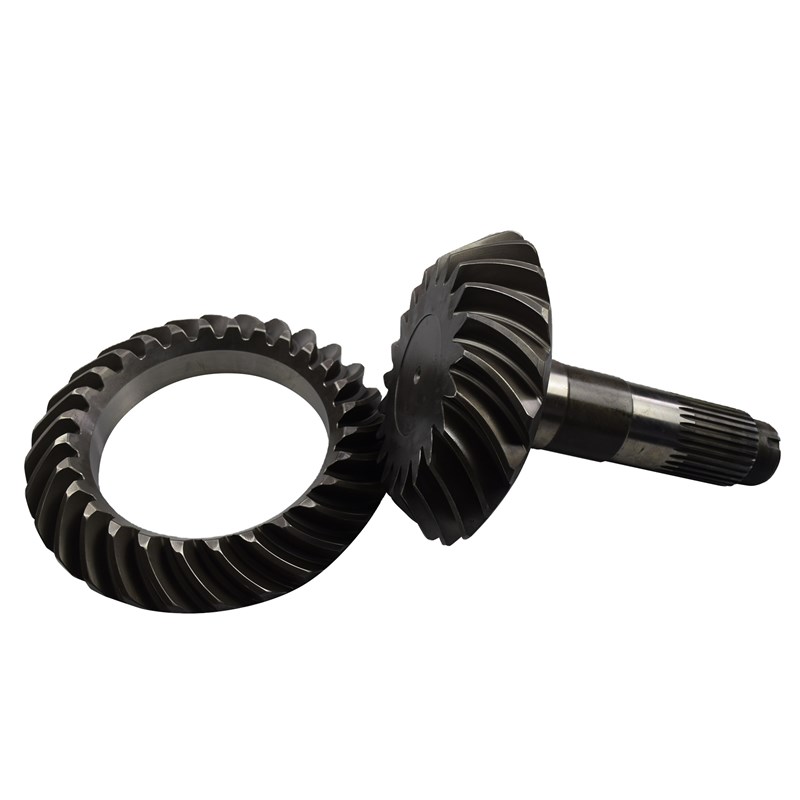
Gearseiko Core Strength: Traceable Precision & Stable Supply
Constrained by outer dimension and mean cone distance, tolerance parameters including cumulative pitch, tooth profile and helix deviation are defined accordingly. Gearseiko is capable of issuing complete inspection documents complying with AGMA, DIN and ISO regulations. Each batch of goods attaches 3D dimensional test data, realizing full quality traceability and verification.
We supply diversified bevel gear products, including hardened ground high-precision Grade 6 gears and economical milled Grade 9 gears, featuring reliable quality, flexible delivery cycle and competitive pricing.
Submit your technical parameters such as power rating, rotating speed, shaft angle and mounting distance to our technical team. We will recommend the most cost-efficient accuracy grade scheme and provide free sample inspection reports. Proper grade selection lays solid foundation for reliable precision transmission.
Visit our official website //www.gearseiko.com for more bevel gear technical support and one-stop procurement service.
FAQ: Bevel Gear Accuracy Grade Selection
Q1: Which bevel gear grades are commonly used in actual production?
A1: Grade 5 to Grade 10 are mainstream practical grades; Grade 1-3 are theoretical ultra-precision levels with limited industrial application.
Q2: What application scenarios suit Grade 5 and Grade 6 high-precision gears?
A2: They apply to high-speed heavy-load equipment like aerospace drives, precision machine tools and racing transmission systems.
Q3: What key factors determine the selection of bevel gear accuracy grade?
A3: Peripheral speed, transmitted power, motion accuracy requirement and vibration noise control standard.
Q4: What quality certification standards can Gearseiko inspection reports comply with?
A4: Inspection documents conform to AGMA, DIN and ISO international standards with complete 3D measurement data.
How Gearseiko Ensures High-End Transmission Precision
How Gearseiko Defines a New Standard for High-End Drives
Related Article