How Gearseikos Precision Gear Machines Redefine Gear Manufacturing Accuracy Efficiency
author: Cash
2026-05-28
Beyond Basic Machining: How Gearseiko’s Precision Gear Machines Redefine Gear Manufacturing Accuracy & Efficiency | Gearseiko
In modern mechanical drive systems, gear machining accuracy is a core factor influencing equipment operating performance, running noise and overall service life. To manufacture true high-end precision gears, traditional processing methods including hobbing, shaping and grinding are far from sufficient. Post-processing procedures such as chamfering, deburring, heat treatment, rolling inspection, as well as machining for special tooth profiles like herringbone gears and arc-contact worm gear pairs, also play a decisive role in final product quality.
As a professional provider of comprehensive solutions for high-end precision gear manufacturing, Gearseiko has in-depth insights into the technical difficulties of each production process. We supply a full range of dedicated gear processing equipment that outperforms conventional machinery, helping customers achieve remarkable breakthroughs in machining accuracy and production efficiency across gear chamfering, deburring, heat treatment, quality inspection and special tooth profile manufacturing.Explore our full lineup of specialized gear processing machines and one-stop manufacturing solutions at Gearseiko.
1. Gear Chamfering & Deburring: Upgrade from Simple Burr Removal to Professional Edge Finishing
In mass gear production, sharp tooth tips and burrs on involute profiles will not only hinder assembly, but also easily trigger fatigue cracks on gears under long-term load. Gearseiko’s chamfering and deburring machines are not merely simple trimming equipment.
Gear chamfering machines are designed to create uniform chamfers and rounded corners at gear tooth ends, which effectively improves gear shifting smoothness for transmission systems.
Gear deburring machines perform controlled chamfering on involute tooth flanks and root fillets. They eliminate stress concentration areas and form smooth edge transitions, laying a solid foundation for subsequent surface treatments such as carburizing and quenching.
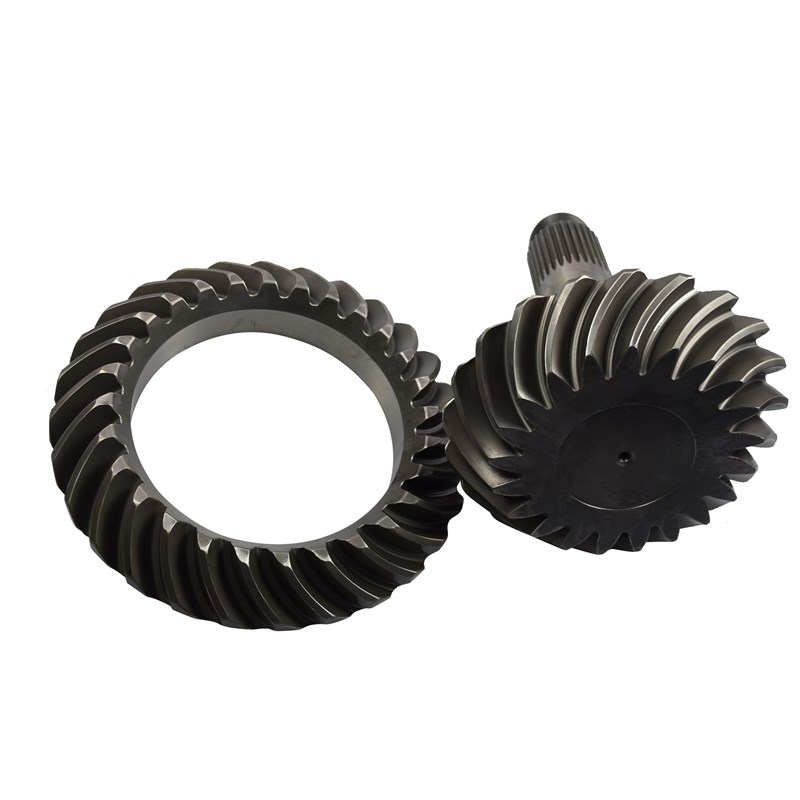
For complex bevel gear workpieces, we have developed differentiated equipment models. Bevel gear chamfering machines are dedicated to end chamfering of spiral bevel gears, while bevel gear deburring machines complete width-direction chamfering on tooth tips. The combined application ensures interference-free meshing and low-noise operation of bevel gear sets.
2. Full-Process Control for Bevel Gears: From Precision Quenching to Rolling Testing
Contact pattern analysis is the key quality inspection link for bevel gears. Gearseiko bevel gear rolling testers simulate actual meshing status to accurately detect the position, shape and size of contact patterns. By quantifying contact pattern deviation and contact trace width, the equipment guides customers to carry out targeted tooth flank modification before assembly, so as to avoid large-batch defective products.
Heat treatment distortion has long been a major challenge restricting bevel gear production. Gearseiko bevel gear quenching machines adopt press quenching technology with custom fixtures and precise cooling rate control, limiting tooth profile distortion within micron level. This reduces grinding allowance, shortens machining cycle, and optimizes the distribution of residual compressive stress on tooth surfaces.
3. Herringbone Gears & Worm Hone Sharpening: Professional Solutions for Special Tooth Profiles
Herringbone gears feature zero axial thrust and outstanding load-bearing capacity, and are widely applied in marine propulsion systems and heavy-duty reducers. Nevertheless, the alternating left and right helical tooth flanks bring great difficulties to ordinary processing equipment. Gearseiko herringbone gear milling machines and planing machines adopt disk cutters and planing tools with generating motion respectively, delivering high-symmetry tooth surfaces and precise centering effect. The planing machine is especially suitable for large-module, wide-face heavy-duty herringbone gears.
The precision of worm-shaped hones directly determines the surface finish of finished gears after honing. Gearseiko worm hone sharpening machines can precisely regrind worn hones to restore original tooth profile accuracy and surface state. It effectively extends tool service life and cuts down overall tooling costs.
4. Cold Roll Forming & Arc-Contact Worm Gear Pairs: Advanced High-Efficiency Forming Technology
For mass production of spline shafts and small-module gears, material utilization rate and processing cycle are core indicators. Gearseiko gear rolling machines follow the principle of die cold extrusion, and form gear teeth via radial or axial rolling to generate continuous metal flow lines. Compared with cutting processes, cold rolling realizes near-net shape forming, lifts material utilization by more than 30%, and creates work hardening layers on tooth surfaces to enhance pitting resistance.
We also provide dedicated milling machines for arc-contact worm gear pairs including globoidal worms and spherical worm wheels. The equipment applies continuous indexing technology: the turning tool on the worktable processes arc-contact worms, while the fly cutter on the spindle machines spherical worm wheels. This dual-function design enables the worm gear pair to form stable oil film load areas during meshing, making it the ideal choice for heavy-duty precision indexing equipment.
5. Cylindrical Gear Milling Machines: Optimization for Classic Machining Equipment
Even in the era of CNC intelligent manufacturing, rough milling of cylindrical gears still demands high equipment rigidity and operational reliability. Gearseiko cylindrical gear milling machines are developed for spur and helical gears, equipped with disk cutters and finger cutters to support stable machining under heavy cutting parameters. We optimize spindle torque performance and worktable indexing accuracy, ensuring uniform remaining machining allowance after rough milling and creating optimal conditions for follow-up grinding and honing processes.

Build Reliable Precision Support for Your Production Line
Gearseiko focuses on building a complete gear process chain rather than supplying standalone machines. Our full-series equipment covers chamfering, deburring, heat treatment, rolling testing and special tooth machining, all developed based on in-depth research on gear failure mechanisms. Whether you need to reduce transmission noise, improve load capacity or shorten production cycles, our specialized gear processing machines will be your reliable technical partner.
Feel free to contact our team for customized solutions targeting your gear manufacturing bottlenecks. Gearseiko – Precision gear machines that go beyond standards, exceeding expectations. (All technical parameters and application effects are sourced from actual production tests.)
FAQ: Specialized Gear Processing Technology & Equipment
Q1: What are the main functions of gear chamfering and deburring machines?
A1: Chamfering machines make uniform chamfers at tooth ends for smoother gear shifting; deburring machines remove burrs on tooth flanks and root fillets to eliminate stress concentration and facilitate post heat treatment.
Q2: How does the bevel gear quenching machine solve distortion problems?
A2: It uses press quenching with dedicated fixtures and controlled cooling rate, keeping tooth profile distortion within micron range, reducing grinding allowance and optimizing residual stress distribution.
Q3: What equipment is used for herringbone gear machining?
A3: Herringbone gear milling machines and planing machines are available. The planing model is more suitable for large-module, wide-face heavy-duty herringbone gears.
Q4: What advantages does gear cold rolling have over traditional cutting?
A4: It improves material utilization by over 30%, forms continuous metal flow lines and surface work hardening, and greatly enhances gear pitting resistance.
Q5: What are the application features of arc-contact worm gear milling machines?
A5: It processes matched worm and worm wheel in one machine. The gear pair can form stable oil film during meshing, perfect for heavy-duty precision indexing scenarios.
Why Preliminary Heat Treatment Defines High End Gear Performance
Gearseiko Empowers High End Drive Systems with Ultimate Accuracy
Related Article