Flame Hardening Process Explained by Gearseiko
author: Cash
2026-05-28
Unlocking Gear Durability: Flame Hardening Process Explained by Gearseiko | Gearseiko
In high-precision gear manufacturing, surface hardening is a core procedure that directly decides gear service life and operational performance. Among diverse heat treatment technologies, flame hardening gains wide recognition for great flexibility, cost efficiency and adaptability to large-sized or non-standard gears. As a professional manufacturer of high-end precision gears, Gearseiko has accumulated in-depth know-how in flame hardening. This article elaborates on the working principles of gear flame hardening, and how our rigorous process control creates long-term value for clients.Discover reliable flame hardening solutions and premium precision gears from Gearseiko.
Precise Temperature Control: The Core of Flame Hardening
The fundamental principle of flame hardening is straightforward: heat gear tooth surfaces above the phase transformation temperature, then perform rapid quenching to form a hard martensitic layer. Nevertheless, the success of this process hinges entirely on accurate temperature regulation during heating.
Gearseiko strictly manages three interrelated key parameters: nozzle layout, heat output and heating duration. Any deviation will directly compromise final product quality:
- Insufficient heating: Low temperature or inadequate heating time leads to shallow, uneven hardened layers and soft spots. Gears with such defects will suffer premature wear, pitting or tooth fracture under load.
- Overheating: Excessively high temperature tends to trigger quenching cracks. In severe cases, tooth surfaces may get burnt or even melted, resulting in complete scrap.
For this reason, all flame hardening systems at Gearseiko are equipped with high-precision temperature monitors and adjustable nozzle groups. Our process engineers calculate the optimal heating curve in advance according to gear material, module, tooth geometry and other specifications, to guarantee full austenitization of tooth surfaces within a controlled temperature range.
Two Major Flame Hardening Technologies for Different Gears
Gearseiko adopts two mainstream flame hardening processes, customized to match gear module and application requirements.
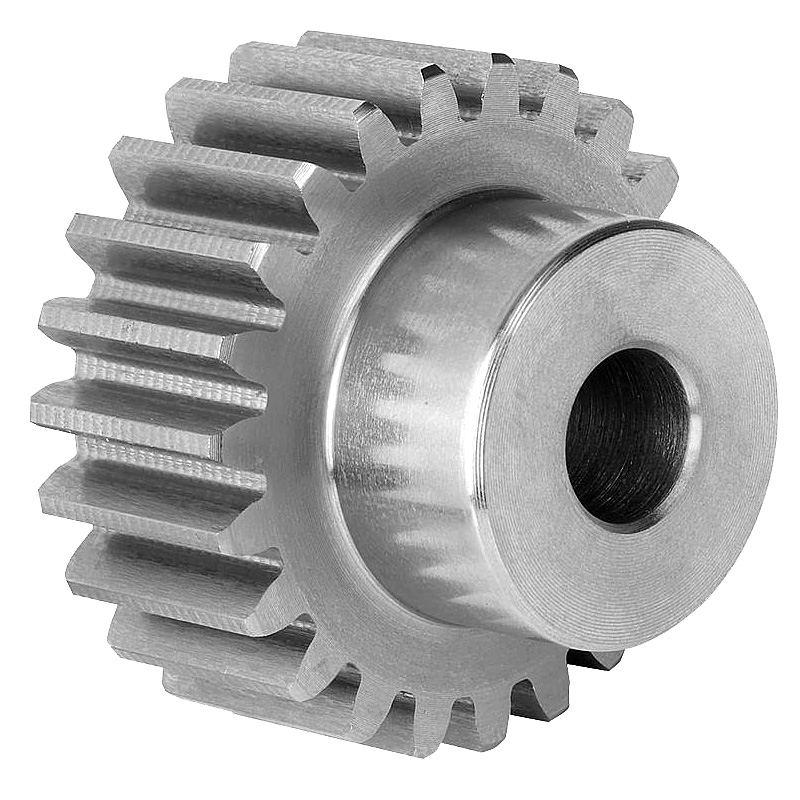
1. Full Gear Spin Hardening – Ideal for Small Module Gears
This method is the most cost-effective and efficient option for gears with a module below 6 mm. The gear is fixed on a rotating worktable; multiple flame nozzles heat the entire tooth profile circumference simultaneously, followed by overall quenching.
Our technical strengths lie in optimized gap between nozzles and tooth tips, as well as matched rotation speed and heating power. These settings deliver uniform case depth across the whole gear and shorten heating time effectively, preventing overheating at tooth tips. The final hardened depth is mainly determined by heating temperature and holding time. We define the most suitable case depth based on customers’ actual working conditions such as impact load and contact stress.
2. Single-Tooth Progressive Flame Hardening – For Large Module Gears
For gears with a module over 8 mm or special tooth profiles, overall heating is impractical. A large temperature gap between tooth roots and tips will generate intense thermal stress and raise cracking risks. Under such circumstances, single-tooth progressive hardening is the preferred solution, which includes two typical techniques:
- Tooth-flank tracing method: The nozzle moves along tooth flanks from root to tip or the reverse direction. Each tooth is heated individually and quenched immediately. It fits large-module gears with moderate tooth height.
- Tooth root tracing method: The nozzle targets tooth roots and moves along the root direction. Since heat dissipates faster at roots than on flanks, we equip dedicated nozzles with extra flame outlets for root areas to ensure sufficient heat input. This forms a continuous and uniform hardened layer on the whole tooth profile and eliminates the critical defect of soft tooth roots.
Multiple factors interact to affect case depth in single-tooth progressive hardening, including oxygen pressure, moving speed of nozzles or workpieces, gap between flame outlets and quenching outlets, as well as preheating temperature. Different steel grades require exclusive distances between flame and quenching ports. Gearseiko has built a comprehensive process database covering common gear steels like 42CrMo, 40Cr and 20CrMnTi, enabling quick selection of optimal parameter combinations.
Avoid Temper Softening: Adjacent Tooth Cooling Design
A commonly neglected but vital issue in single-tooth progressive hardening is temper softening on adjacent hardened teeth. When heating one tooth, heat conduction may rewarm the already processed neighboring teeth, which softens the martensitic structure and causes obvious hardness loss.
To solve this problem, Gearseiko integrates water cooling channels into nozzle assemblies. The system continuously sprays coolant on two adjacent tooth flanks, keeping the hardened areas at low temperature and free from thermal impact. Thanks to this detailed design, our gears maintain consistent hardness from tooth to tooth even in mass production.
Gearseiko’s Quality Promise
Though flame hardening is a traditional heat treatment technique, sophisticated process control and technical expertise distinguish outstanding precision gear manufacturers. Gearseiko masters all the above flame hardening methods. More importantly, we develop tailored solutions by taking gears’ operating conditions, potential failure modes and cost budgets into consideration.
Whether you need spin hardening for small-module gears or single-tooth progressive hardening for large ring gears, Gearseiko delivers durable precision gears. If you are searching for a gear supplier with solid technical capabilities and stable mass production capacity, feel free to get in touch with us.
Gearseiko – The hard-power choice for precision gears
FAQ: Gear Flame Hardening Technology
Q1: What is the basic principle of gear flame hardening?
A1: It heats tooth surfaces above phase transformation temperature and then quenches rapidly to form a martensitic hardened layer, improving gear surface hardness and durability.
Q2: What problems will insufficient or overheating cause?
A2: Insufficient heating leads to uneven case depth and soft spots, causing early wear and pitting. Overheating results in quenching cracks, burnt surfaces or even scrapped gears.
Q3: Which gears are suitable for full gear spin hardening?
A3: It is mainly applied to gears with a module less than 6 mm, featuring high efficiency and low cost.
Q4: What are the two types of single-tooth progressive hardening?
A4: They are tooth-flank tracing method and tooth root tracing method. The latter effectively avoids soft root defects for large gears.
Q5: How does Gearseiko prevent temper softening of adjacent teeth?
A5: We adopt nozzles with built-in water channels to cool adjacent teeth continuously during processing, so as to keep stable hardness.
How Gearseiko Delivers High-Performance Power Transmission with Advanced Gas Carburizing Technology
Why Preliminary Heat Treatment Defines High End Gear Performance
Related Article