Gearseikos Approach to High‑Precision Manufacturing
author: Cash
2026-06-24
Arc Gear Hobbing: Gearseiko’s Approach to High‑Precision Manufacturing | Gearseiko
Arc gears, also known as circular arc gears, have become indispensable core transmission components for high-end mechanical equipment, thanks to their outstanding meshing performance and superior heavy-load bearing capacity. Compared with conventional involute gears, arc gears deliver remarkable strengths in smoother transmission operation, higher torque tolerance and longer overall service life. As a professional manufacturer focusing on full-process high-precision gear production, Gearseiko has accumulated mature and proprietary core technologies for arc gear hobbing. We provide stable, high-accuracy arc gear components and one-stop manufacturing solutions for global high-end transmission industries.
1. Working Principle of Arc Gear Hobbing
Arc gear hobbing adopts standard CNC gear hobbing machines matched with dedicated arc gear hobs, applying a unique semi-generating cutting principle. It is fundamentally different from the full enveloping cutting mode of traditional involute gear hobbing:
The tooth flanks of arc gears are not formed by continuous envelope motion of the hob cutter. Instead, special hobs directly cut out integrated smooth circular arc tooth profiles in one forming process. Besides, paired arc gear sets consist of convex gears and concave gears, which require two sets of independent dedicated hobs for separate machining respectively.
This special cutting principle puts forward extremely stringent requirements for machine parameter debugging, especially the calculation accuracy of indexing change gears and differential change gears. Apart from exclusive cutter configuration, most machine debugging operations keep consistent with ordinary involute cylindrical gear hobbing, including indexing and differential gear calculation, hob arbor alignment, hob clamping centering, fixture calibration and workpiece blank positioning. Gearseiko controls every minor process detail strictly to eliminate hidden precision risks in advance.
2. Precision Change Gear Adjustment: Core Process of Arc Gear Hobbing
Change gear matching and calculation is the most critical process link that determines the final meshing precision of arc gears. Four groups of change gears need to be configured accurately during hobbing: speed change gears, feed change gears, indexing change gears and differential change gears.
The overall adjustment procedure is basically consistent with involute helical gear hobbing, while there is one core difference: the helix angle of arc gears directly affects axial pitch, and axial pitch consistency decides the running stability and meshing smoothness of the whole gear pair. Therefore, differential change gears for arc gears require far higher calculation precision than conventional involute gears.
Gearseiko formulates two strict internal precision standards for differential change gear calculation targeting different production scenarios:
-
Small transmission ratio gear pairs: Both matched large and small arc gears are processed on the same hobbing machine with completely identical change gear ratios, ensuring 100% matching helix angles of paired gears and zero meshing deviation.
-
Large transmission ratio gear pairs: When two matched gears have huge diameter gaps and cannot be produced on one single machine, we control the maximum calculation error of differential change gears within ≤0.00001 (one hundred-thousandth), which is far beyond the average precision standard of the gear manufacturing industry.

3. Full-Process Closed-Loop Process Control System
Qualified high-precision arc gears rely not only on accurate change gear calculation, but also standardized control of every machining procedure from workpiece clamping to finished cutting. Gearseiko builds a complete full-process quality control system covering the whole hobbing workflow:
3.1 High-precision Tool and Workpiece Alignment
We calibrate hob arbor runout, hob concentricity, fixture positioning accuracy and workpiece blank centering repeatedly with professional high-precision measuring instruments. All tool and workpiece relative position errors are controlled within micron-level tolerance, avoiding tooth profile deflection and pitch deviation caused by clamping misalignment.
3.2 Customized Cutting Parameter Optimization
Our professional process engineers adjust cutting speed, feeding rate and cutting depth dynamically based on gear module, tooth number, workpiece material and batch size. The optimized parameters balance high production efficiency, perfect tooth surface finish and extended service life of special arc hobs, reducing tool wear and cutting vibration effectively.
3.3 Full-item Finished Product Precision Inspection
Each finished arc gear will undergo full dimensional detection, including tooth profile error, helix lead accuracy, single pitch error and cumulative pitch error. Unqualified products will be directly eliminated to guarantee all delivered gears meet design drawing requirements and industrial precision standards.
4. Application Advantages & Industrial Scenarios of Arc Gears
Benefiting from unique convex-concave meshing structure, arc gears have prominent performance advantages that involute gears cannot match: their tooth surface contact strength is 0.5-1.5 times higher than involute gears, and transmission efficiency can stably reach over 99%. They perform excellently under heavy-load, high-speed and impact working conditions.
Now high-precision arc gears are widely applied in multiple core industries:
-
Metallurgical continuous rolling equipment
-
Heavy-duty mining machinery and crushers
-
Marine main propulsion transmission systems
-
Wind turbine main gearboxes
-
High-precision heavy-duty industrial reducers
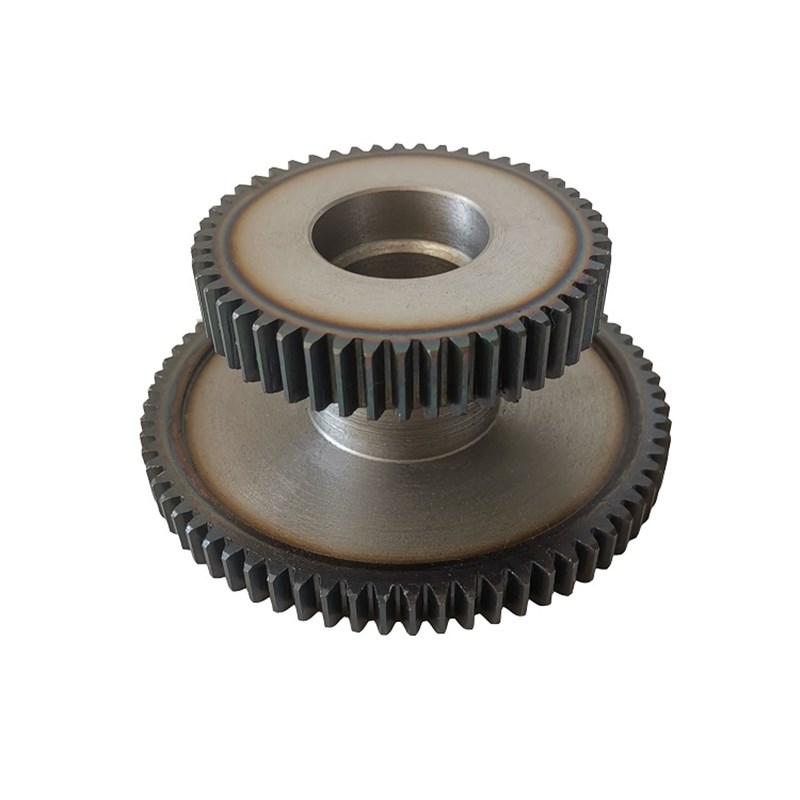
5. Gearseiko Manufacturing Strength & Service Commitment
Adhering to the brand philosophy of Precision Drives the Future, Gearseiko keeps upgrading arc gear hobbing equipment and optimizing process parameters continuously. Equipped with full-series high-precision CNC hobbing machines, professional process R&D team and independent precision testing laboratory, we support full-chain services from blank forging, rough hobbing, finish hobbing, heat treatment to final precision inspection.
We provide both standard arc gear bulk production and non-standard customized solutions for special harsh working conditions. With strict process standards, ultra-high machining precision and reliable after-sales technical support, Gearseiko is your trustworthy long-term partner for high-end precision transmission gear components.
Ultra-precise change gear matching plus standardized full-process hobbing control, Gearseiko delivers zero-error arc gear pairs for heavy-duty high-speed transmission systems.
FAQ | Arc Gear Hobbing Technology
Q1: What is the difference between arc gear hobbing and involute gear hobbing?
A1: Arc gear hobbing adopts semi-generating forming cutting instead of full enveloping motion; convex and concave matched gears need two separate special hobs, and differential change gears require much stricter calculation precision than ordinary involute gears.
Q2: Why are differential change gears so critical for arc gear machining?
A2: Differential change gear accuracy directly affects gear helix angle and axial pitch. Tiny calculation errors will cause poor meshing, obvious vibration and accelerated wear of arc gear pairs.
Q3: What error standard does Gearseiko follow for differential change gears?
A3: For cross-machine production of matched gears, we control differential change gear calculation error within 0.00001, far higher than general industrial manufacturing standards.
Q4: What are the performance advantages of arc gears compared with involute gears?
A4: Higher tooth surface contact strength, stronger impact resistance, transmission efficiency above 99%, smoother operation and longer service life under heavy-load working conditions.
Q5: Can Gearseiko provide customized non-standard arc gears?
A5: Yes. We can customize exclusive arc gear hobbing solutions and special hobs according to customers’ special working conditions, transmission ratio and precision requirements.
Q6: Do arc gear pairs need to be processed on the same hobbing machine?
A6: It is recommended for gears with small transmission ratios to guarantee fully consistent helix angles. For large transmission ratio gear pairs with huge size differences, we adopt ultra-low error change gear calculation to ensure matching meshing performance.
The Quality Cornerstone of Gearseiko High Precision Gears
Mastering the Three Pillars of Circular Arc Gear Manufacturing
Related Article