A Technical Deep Dive for Precision Engineering
author: Cash
2026-06-22

Mastering Internal Gear Form Milling: A Technical Deep Dive for Precision Engineering | Gearseiko
Large internal gears are indispensable core transmission components widely adopted in wind turbine yaw bearing systems, heavy-duty industrial reducers, mining rotary equipment and marine heavy transmission devices. Different from conventional external gears, internal gear machining faces inherent space limitation, cutter interference and difficult positioning problems, bringing higher technical barriers to mass production. Among mainstream internal gear manufacturing processes, form milling (copy milling) stands out as the preferred solution for large-module, small-batch and high-precision custom internal gears. As a full-service precision gear manufacturer with self-owned R&D team and complete processing equipment, Gearseiko masters two core form milling solutions for internal gears, and summarizes standardized pre-machining feasibility inspection specifications to avoid machining collision and workpiece scrappage. This article makes an in-depth technical analysis of internal gear form milling process for industrial precision engineering reference.
Core Principle of Internal Gear Form Milling
Form milling, also named copy milling, belongs to forming cutting process rather than generating cutting. The axial profile of the milling cutter is completely consistent with the tooth space profile of finished internal gears, realizing one-to-one tooth space forming via single-tooth indexing cutting. Two mature tool solutions are widely used in actual production: disc-type milling cutter and finger-type milling cutter. Correspondingly, we match dedicated internal gear hob head for disc cutters and exclusive finger-type cutter head for finger cutters respectively to adapt to different gear diameters, modules and helix angles. The whole process is flexible for customized production and perfectly fits small-batch large-module internal gear orders that gear shaping and conventional hobbing cannot process efficiently.
1. Disc-Type Milling Cutter: High-Precision Milling with Hob Head Angle Adjustment
1.1 Gear Ratio Calculation Standard
When adopting disc-type milling cutters for internal gear machining on vertical or horizontal gear hobbing machines, the indexing change gear and differential feed change gear calculation formulas are completely consistent with single-index form milling process for external gears. The unified computing standard reduces parameter debugging errors and shortens machine setup time greatly.
1.2 Key Angle Adjustment for Helical Internal Gears
The biggest difference between helical internal gear and external gear form milling lies in hob head swinging adjustment. To match the spiral lead angle of helical internal gears, technicians must swing the internal gear hob head correspondingly, making the cutter cutting direction parallel to gear tooth direction, so as to avoid tooth profile distortion and flank scratch.
1.3 Center Offset Compensation Correction
Hob head swinging will cause the disc cutter to deviate from the worktable center, destroying standard cutting position and affecting overall tooth uniformity. Gearseiko adopts precise axial offset compensation for hob head to calibrate cutter center position. Our process team calculates compensation data according to gear module, helix angle and cutter specification, ensuring complete tooth profile accuracy and smooth tooth flank surface after cutting.
2. Finger-Type Milling Cutter: No Angle Swinging, Higher Structural Adaptability
2.1 Simplified Machine Setup Process
Compared with disc milling cutters, finger-type milling cutters have the core advantage of no need for hob head swinging. Whether machining spur internal gears, helical internal gears or special herringbone internal gears, the cutter head can keep vertical without angle adjustment. It eliminates precision risks caused by angle swinging and center offset compensation, greatly lowering machine debugging difficulty.
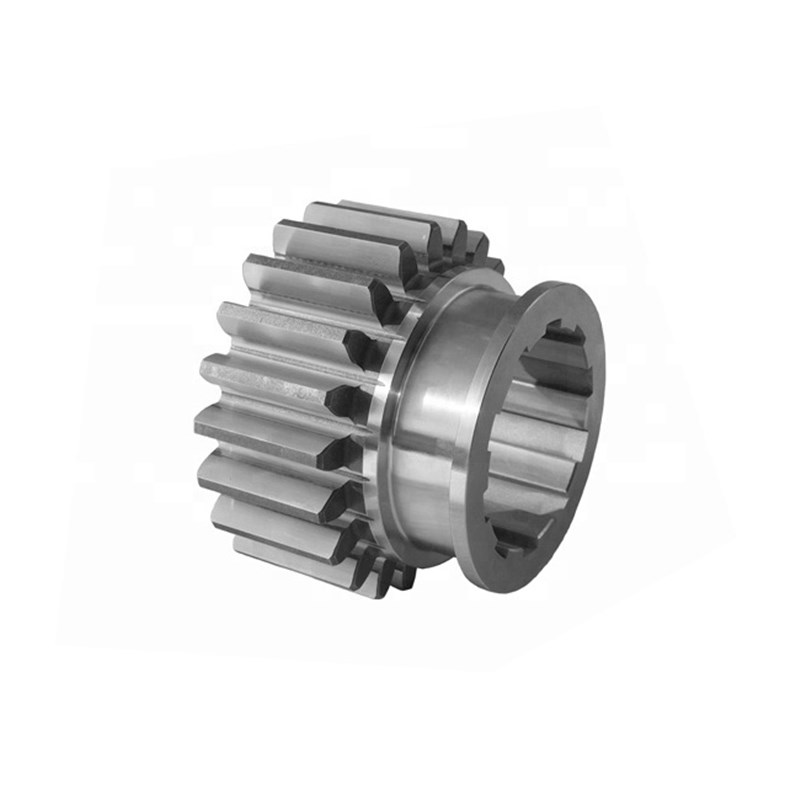
2.2 Applicable Machining Scenarios
Finger-type milling cutters are the optimal choice for large-diameter and super-large-module internal gears. For oversized internal gear workpieces, swinging huge disc cutter heads will damage machine rigidity and cause severe cutting vibration. Besides, finger cutters have no inner space clearance limit, solving the machining bottleneck that disc cutters cannot access narrow inner bores. At Gearseiko, we apply finger-type form milling for extra-large module internal gears and herringbone internal gears to achieve stable and high-precision forming.
Three Mandatory Pre-Machining Feasibility Inspections (Gearseiko Standard SOP)
Due to the closed inner bore machining environment of internal gears, cutter collision, workpiece interference and fixture extrusion are the most common hidden risks in form milling. Before every formal cutting process, Gearseiko implements three full-dimensional feasibility inspections as mandatory standard procedures to prevent equipment failure, workpiece damage and production downtime:
2.1 Cutter Head Entry Bore Clearance Inspection
The primary inspection item is to verify whether the cutter head can smoothly enter the inner bore of internal gear blank. If the inner aperture is too small to accommodate matched cutter head, form milling will be infeasible directly. In this case, our engineers will switch to alternative processes such as gear shaping according to workpiece parameters, avoiding blind trial cutting.
2.2 Full-Depth Radial Anti-Interference Inspection
When the cutter cuts to full tooth depth, the side wall of cutter head is easy to collide with gear tooth tip circle. We simulate full-depth cutting track in advance via professional simulation software. Once interference is detected, we will optimize the process scheme: adopting larger-diameter disc milling cutters or lengthening cutter shank of finger milling cutters to reserve sufficient radial safety clearance.
2.3 Full-Stroke Collision Inspection for Fixture and Machine Components
We conduct full-stroke simulation covering cutter head, workpiece, clamping plate, fastening bolt and fixture base, focusing on the limit lowest cutting position. All potential collision risks between cutter assembly and machine housing or fixture components must be eliminated. We adjust axial and radial extension length of cutter head targeted to guarantee zero collision throughout the whole cutting cycle.
Gearseiko Comprehensive Internal Gear Manufacturing Strength
Relying on self-owned R&D engineers and full-series high-precision gear processing equipment including ARBURG and +GF+ FORM P 350 machines, Gearseiko supports full-process production of various internal gears. We not only provide two form milling solutions for large internal gears, but also offer gear shaping, precision finishing and heat treatment integrated services. Meanwhile, we supply precision gear prototypes and professional mirror rotary EDM services, covering standard and non-standard gears from M0.15 to M1.5, as well as customized racks, sprockets, timing pulleys, worm gears and bevel gears.
Our internal gear products are widely used in wind power energy, automated robotics, construction machinery, aerospace equipment, marine transmission and industrial automation production lines. We support both OEM and ODM customized services, matching the most cost-effective machining process according to production batch, gear module, precision requirement and workpiece structure for every client.
Conclusion
Disc-type milling cutters fit high-precision internal gear production requiring helix angle adjustment, while finger-type milling cutters adapt to large-diameter and special-shaped internal gears with simpler setup. Complete pre-machining three-step feasibility inspection is the core guarantee for safe and efficient form milling. Choosing a reasonable form milling process and standardized pre-inspection flow can effectively improve internal gear surface quality, control tooth profile error and reduce production risk.
With mature form milling technology, strict pre-production inspection system and full-chain precision manufacturing capability, Gearseiko solves various difficult machining problems of large internal gears, delivering durable, high-precision internal gear components for global heavy-duty transmission industries.
Standardized form milling process and strict pre-machining inspection eliminate internal gear cutting interference risks and stabilize final gear precision.
FAQ | Internal Gear Form Milling Technology
Q1: What is the difference between internal gear form milling and generating hobbing?
A1: Form milling adopts forming cutter for single-tooth indexing cutting, suitable for large-module small-batch internal gears; generating hobbing is for mass production of medium and small module internal gears with higher efficiency but larger equipment limitation.
Q2: What are the applicable scenarios of disc milling cutter and finger milling cutter?
A2: Disc cutters are for high-precision spur and helical internal gears with standard bore size; finger cutters fit large-diameter, super-large-module and herringbone internal gears without hob head angle adjustment.
Q3: Why need hob head swinging compensation for helical internal gear disc milling?
A3: Hob head swinging matches gear helix angle for qualified tooth profile; meanwhile axial offset compensation is required to correct center deviation caused by angle swinging.
Q4: What collision risks exist during internal gear form milling?
A4: Main risks include cutter head bore entry interference, full-depth tooth tip collision, and collision between cutter assembly and fixtures or machine parts during cutting stroke.
Q5: When will gear shaping replace form milling for internal gear processing?
A5: When the inner bore diameter is too small to allow cutter head entry and form milling cannot meet clearance requirements, gear shaping will be adopted as the alternative process.
Q6: What one-stop internal gear services can Gearseiko provide?
A6: We provide process selection, free feasibility inspection, formal milling processing, heat treatment, precision detection, gear prototype customization and mirror rotary EDM services, supporting full-dimension non-standard internal gear OEM & ODM.
A High Accuracy Alternative When Large Gear Shapers Are Unavailable
The Gearseiko Approach to Precision Machining
Related Article