2026 Revolutionizing Gear Drive Reliability Breaking Free from Traditional Models for Next-Generation Precision Systems
author: Cash
2026-04-29
2026 Revolutionizing Gear Drive Reliability: Breaking Free from Traditional Models for Next-Generation Precision Systems | Gearseiko
In the realm of mechanical engineering, reliability design was once hailed as a revolutionary shift—fundamentally transforming safety philosophies and design criteria. Yet despite decades of progress, the theoretical and methodological frameworks of reliability remain far from fully meeting real-world engineering demands.
For critical power transmission systems, especially gear drives, this gap becomes even more pronounced. At Gearseiko, we recognize that reliable gear systems are not merely about applying textbook models—they demand deep insight into unique failure mechanisms, dynamic loading behaviors, and system-level interdependencies. Explore Gearseiko’s next-generation gear reliability solutions here.
The Unfinished Revolution in Mechanical Reliability
Reliability engineering has matured significantly, driven by four key factors:
-
Increasing complexity of high-end mechanical products
-
Rising global expectations for product quality and durability
-
Stringent safety and environmental compliance requirements
-
The industry push for sustainable, long-lifecycle development
Concepts such as reliability-centered design, reliability-oriented manufacturing, and condition-based maintenance have evolved rapidly. However, most reliability theories—including first-order and second-order moment methods, response surface approaches, and traditional system reliability models—were developed primarily for electrical and electronic systems.
These methods rely on inherent assumptions that rarely hold true for mechanical systems:
-
Independent failures among individual components
-
Constant failure rates throughout the service life
-
Exponentially distributed component lifetimes
When these assumptions are applied indiscriminately to mechanical drives, the results can be misleading or even dangerous. For example, traditional reliability allocation for large-scale series systems often yields unrealistic or economically unviable outcomes. The reality is that mechanical systems differ fundamentally from electronic ones in load characteristics, wear mechanisms, and time-dependent degradation.
Why Gear Drives Are Different—And Why It Matters
Gear transmission systems are inherently series systems—failure of any single component (gear, bearing, shaft) compromises the entire drivetrain. However, unlike typical series systems, gearboxes exhibit unique operational features that traditional models fail to capture:
-
Alternating tooth engagement patterns during operation
-
Cyclic stress distribution across gear teeth
-
Strong failure correlations under random external loads
Traditional reliability studies often treat a gear as a single component, or worse, treat individual teeth as independent components in a series arrangement. This approach neglects three critical realities of gear operation:
-
Teeth engage sequentially, not simultaneously
-
Loads are shared dynamically across meshing teeth
-
Failure of one tooth can propagate to adjacent teeth
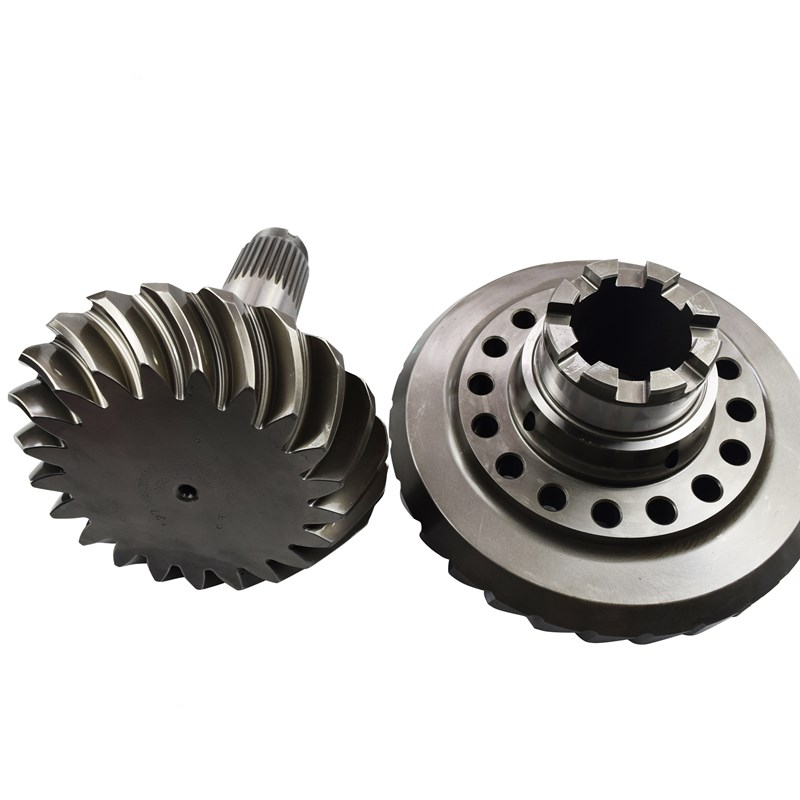
Case 1: Bending Fatigue Failure
Bending fatigue typically initiates at one tooth (often the most stressed or poorly manufactured one) and then propagates to adjacent teeth. The probability characteristics of tooth count—how many teeth are engaged, their load distribution, and their material uniformity—significantly influence overall gear reliability. This critical factor is seldom captured by conventional reliability models.
Case 2: Contact Fatigue (Pitting)
For contact fatigue (a common failure mode resulting in tooth surface pitting), when external loads are stochastic (e.g., variable torque in industrial machinery), the failures of meshing tooth pairs become statistically correlated. Assuming independence under these conditions can lead to reliability predictions that deviate dramatically from actual service life, risking premature equipment failure.
The Gap Between Theory and Engineering Reality
Despite decades of academic and industrial research, few dedicated methods or models have been developed that fully account for the operational peculiarities of gear systems. Different gear structural parameters, loading environments, and failure modes demand tailored reliability approaches—a one-size-fits-all model simply does not work.
This gap is particularly critical for high-end precision gears used in demanding applications:
-
Aerospace transmission systems
-
Electric vehicle drivetrains
-
Wind turbine gearboxes
-
Industrial robotics and servo systems
In these fields, unexpected downtime or premature gear failure is unacceptable—costing time, money, and even safety. Learn more about Gearseiko’s simulation-driven gear reliability analysishere.
Gearseiko’s Approach: Reliability by Design, Not by Approximation
At Gearseiko, we have moved beyond generic reliability frameworks, developing a gear-specific approach that bridges the gap between theory and practice. Our engineers integrate failure-mechanism-specific analyses into every stage of design and manufacturing, focusing on three core principles:
1. Failure-Mechanism-Specific Modeling
Instead of assuming independent tooth failures or constant hazard rates, we perform stress-strength interference modeling that respects the alternating nature of tooth contact, load-sharing dynamics, and stochastic operational profiles. This ensures our reliability predictions align with real-world gear behavior.
2. Advanced Simulation Techniques
We apply cutting-edge simulation methods—including finite element analysis (FEA) combined with probabilistic approaches—that capture the correlated failure behaviors characteristic of real-world gear drives. This allows us to identify potential failure risks early in the design phase, before prototypes are built.
3. Reliability Built Into Manufacturing
We recognize that reliability cannot be “tested in” at the end of production. It must be built through precision manufacturing processes:
-
Controlled tooth flank geometry and micro-finishing
-
Optimized surface integrity to resist fatigue and wear
-
Consistent, repeatable heat treatment processes
-
Rigorous inspection and quality control at every stage
Our closed-loop quality system ensures that design reliability targets are translated into measurable process controls, guaranteeing consistent performance across every gear we produce.
The Road Ahead: Rethinking Gear System Reliability
As industries push toward higher power density, lighter weight, and longer maintenance intervals, the limitations of traditional reliability theory become ever more apparent. The future belongs to manufacturers who understand that gear reliability is a multi-scale, multi-failure-mode challenge—not a statistical approximation.
Gearseiko is committed to advancing the science of gear drive reliability, bridging the gap between academic theory and engineering practice. We don’t just apply generic formulas—we develop gear-specific solutions that address the unique challenges of precision transmission systems.
FAQ: Next-Generation Gear Drive Reliability
Q1: Why do traditional reliability models fail for gear drives?
A1: Traditional models were designed for electronic systems, relying on assumptions (independent failures, constant failure rates) that do not apply to gear drives— which have cyclic stress, dynamic load sharing, and failure propagation.
Q2: What makes Gearseiko’s reliability approach different?
A2: We use failure-mechanism-specific modeling, advanced FEA-probabilistic simulation, and build reliability into manufacturing—instead of relying on generic approximations.
Q3: Which applications benefit most from Gearseiko’s gear reliability solutions?
A3: Our solutions are ideal for high-demand scenarios like aerospace, electric vehicles, wind turbines, and industrial robotics, where downtime and premature failure are unacceptable.
Q4: How does Gearseiko ensure reliability is built into gears, not just tested?
A4: We integrate precision manufacturing processes (controlled geometry, optimized surface integrity, consistent heat treatment) and closed-loop quality control from design to delivery.
Conclusion
For engineers and procurement specialists seeking genuine reliability in precision gear transmissions, the message is clear: demand models that respect the true physics of gear meshing. Choose a partner who doesn’t just apply generic formulas, but who understands how gears really fail—and how to prevent it. That partner is Gearseiko.
Ready to move beyond outdated reliability models? Contact Gearseiko today to discuss your high-performance gear drive requirements.
For more information about Gearseiko’s next-generation gear reliability solutions and high-precision manufacturing capabilities, visit our official website //www.gearseiko.com/ and feel free to contact us for professional consultation.
Gearseiko – Precision drives reliability, reliability drives the future.
2026 From Static Strength to Fatigue Reliability Gearseiko In-Depth Exploration of Gear Life Prediction Methods
2026 Overview of Gear Transmission Reliability Why Planetary Gear Drives Are the Core Choice for High-Precision Equipment
Related Article