2026 Mastering Gear Modification The Key to Reducing Vibration and Noise in High-Precision Drives
author: Cash
2026-04-30
2026 Mastering Gear Modification: The Key to Reducing Vibration and Noise in High-Precision Drives | Gearseiko
In the era of large-scale, high-precision, and complex machinery, the demands on power transmission systems have never been greater. As equipment speeds and loads increase, gear vibration and noise have emerged as critical challenges. At Gearseiko, we specialize in manufacturing high-end precision gears, and we have made gear modification (also known as gear profiling or crowning) a cornerstone of our engineering excellence.
Explore Gearseiko’s custom gear modification and high-precision drive solutions here.
Why Gear Modification Matters for High-Precision Drives
When gears operate under real-world conditions, installation errors, shaft deflections, and elastic deformations cause uneven load distribution along the tooth width and unexpected impact forces during meshing. The consequences are clear: increased noise, reduced service life, and compromised system reliability.
Gear modification—specifically lead modification (axial crowning) and profile modification—directly addresses these issues, making it a critical technology for ensuring the performance and durability of high-precision gear drives.
Lead Modification: Optimizing Load Distribution Along the Tooth Width
Lead modification involves removing a small amount of material along the gear’s face width. In practical operation, misalignment and shaft bending tend to concentrate loads at one end of the tooth, leading to localized stress and premature wear.
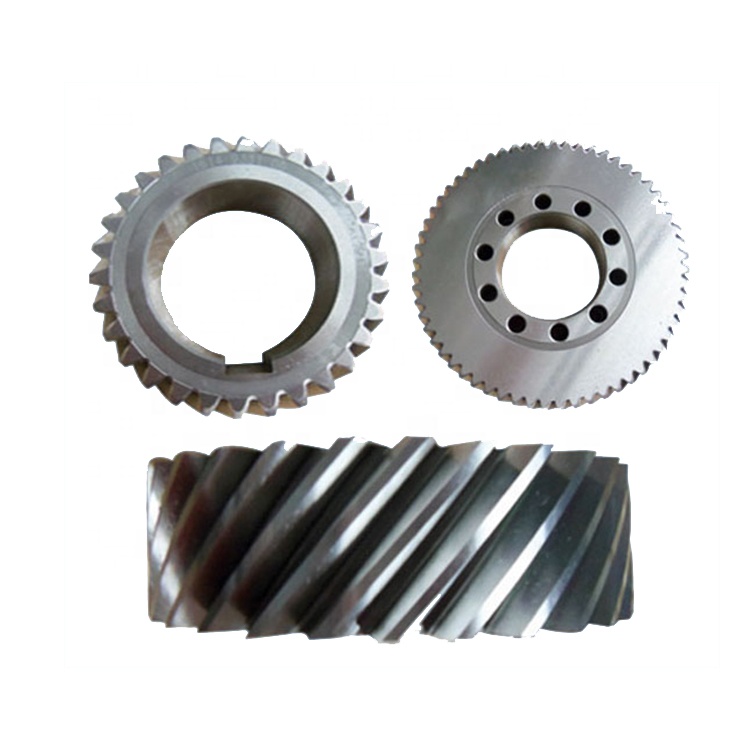
By applying a precise crowning profile, we ensure that the contact load spreads evenly across the entire tooth width. This prevents edge loading, reduces localized stress, and significantly extends gear life. At Gearseiko, our CNC-controlled grinding and shaping processes allow us to achieve lead modification tolerances within microns, ensuring uniform contact even under heavy or fluctuating loads—critical for high-precision spur gears, helical gears, and custom non-standard gears.
Profile Modification: Smoothing the Meshing Process
Profile modification is performed along the tooth height, typically by removing a tiny amount of material near the tip and root. When gears rotate, the transition from one pair of teeth to the next creates a sudden change in stiffness, generating meshing impact and vibration—key sources of gear noise.
By applying a carefully calculated tip relief and root relief, we enable a smoother entry and exit of the tooth pair. This reduces the mesh stiffness variation and effectively suppresses dynamic excitation. The result is quieter operation, lower transmission error, and improved high-speed performance—essential for applications like electric vehicle drivetrains and aerospace actuators.

A Legacy of Research Applied by Gearseiko
The science of gear modification has been developed over decades by pioneers worldwide, with theoretical and experimental advancements that form the foundation of Gearseiko’s engineering practice:
-
Early work by H. Sigg established the concept of meshing impact and provided practical formulas for relief length and amount, laying the groundwork for modern modification techniques.
-
T.F. Conry applied Hertzian contact theory to optimize load distribution along the contact line, improving the accuracy of modification design.
-
In China, researchers like Yang Tingli defined the “three elements” of profile modification—maximum modification amount, modification length, and modification curve—and distinguished between “long modification” for high-overlap helical gears and “short modification” for spur or low-helix-angle gears.
-
Li Dunxin demonstrated that high-speed gears benefit significantly from modification in terms of efficiency and durability, validating its practical value.
-
More recent studies using finite element analysis (by J. Wang, Ma Hui, and others) and genetic algorithms (Yuan Zhe et al.) have confirmed that minimizing static transmission error is the most effective path to vibration reduction.
-
M. Faggioni and A. Bajer further validated that optimized tooth modification dramatically lowers dynamic response under both steady and sudden loads.
At Gearseiko, we do not rely on generic rules. We integrate these proven theoretical foundations with our own advanced simulation capabilities. Using finite element analysis and dynamic modeling, we calculate the optimal lead and profile modification parameters for each customer’s specific operating conditions—including torque, speed, misalignment tolerances, and housing stiffness. Learn more about Gearseiko’s simulation-driven gear modification design capabilities here.
Our Engineering Advantage: Precision Gear Modification at Gearseiko
What sets Gearseiko apart is our end-to-end control of precision modification, ensuring every gear meets the highest standards of performance and reliability:
-
Ultra-precision grinding with in-process measurement ensures that modification profiles are accurate to within 1–2 microns, meeting the strictest tolerances for high-end applications.
-
Custom modification strategies, from short tip relief for spur gears to long parabolic crowning for heavily loaded helical gears, tailored to each customer’s unique requirements.
-
Validation via transmission error testing and noise analysis, so every gear set meets real-world decibel and vibration targets, ensuring consistent performance in application.

FAQ: Gear Modification for Reducing Vibration and Noise in High-Precision Drives
Q1: Why is gear modification essential for high-precision gear drives?
A1: Real-world operating conditions (installation errors, shaft deflection, elastic deformation) cause uneven load distribution and meshing impact. Gear modification solves these issues, reducing vibration, noise, and wear while extending gear service life.
Q2: What are the two main types of gear modification, and what do they do?
A2: Lead modification (axial crowning) optimizes load distribution along the tooth width to prevent edge loading; profile modification (tip/root relief) smooths meshing transitions, reducing stiffness variation and dynamic excitation.
Q3: How does Gearseiko ensure the accuracy of gear modification?
A3: We use CNC-controlled ultra-precision grinding with in-process measurement (accuracy within 1–2 microns), combine simulation-driven parameter design, and validate via transmission error testing and noise analysis.
Q4: Which gear types and applications benefit most from Gearseiko’s custom modification?
A4: All high-precision gears (spur, helical, custom non-standard), especially those for wind turbine gearboxes, electric vehicle drivetrains, aerospace actuators, and high-speed industrial reducers.
Conclusion
Gear modification is not an optional extra—it is an essential technology for modern high-performance machinery. Whether you are designing wind turbine gearboxes, electric vehicle drivetrains, aerospace actuators, or high-speed industrial reducers, reducing vibration and noise while increasing load capacity starts with scientifically designed gear modification.
Gearseiko combines decades of research with state-of-the-art manufacturing to deliver gears that run quieter, last longer, and perform more reliably. Contact us today to discuss how our custom modification solutions can elevate your next project.
For more information about Gearseiko’s custom gear modification services, high-precision gear manufacturing capabilities, and ODM/OEM services, visit our official website //www.gearseiko.com and feel free to contact us for professional consultation.
Gearseiko – Precision Modification, Quiet Reliability.
2026 Precision Gear Reliability Engineering Practice of State Function and Limit State Equation
2026 From Geostatistics to Precision Gear Manufacturing How the Kriging Model is Reshaping High-End Gear Reliability and Design Optimization
Related Article